
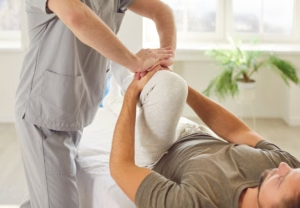
Roughly one in five American adults lives with chronic pain, according to CDC surveillance data, and a large share of them have been told to sim
ply rest. That advice backfires. Physical therapy works in the opposite direction, using graded movement, loading and hands-on care to rebuild the strength and tolerance that months of guarding quietly erased.
Pain that lasts longer than three months behaves differently from a fresh injury. The tissue damage may have healed years ago, yet the nervous system keeps sounding an alarm, and the body adapts around it in ways that make the problem self-sustaining.
What Months of Guarding Do to the Body
When something hurts, people move less, shift weight to the other side and brace through the trunk. Those protective habits make sense for a week or two. Held for a year, they produce measurable losses.
- Muscle atrophy: disuse can cut strength in a limb noticeably within weeks, and deep stabilizers around the spine and hips tend to shut down first.
- Joint stiffness: reduced range of motion in a hip or shoulder forces neighboring joints to compensate, which is why one painful knee often becomes a painful low back.
- Cardiovascular deconditioning: less walking means lower aerobic capacity, more fatigue and a lower threshold for everyday tasks.
- Central sensitization: the spinal cord and brain amplify incoming signals, so pressure that should feel like pressure registers as pain.
That last item explains why imaging often fails to match symptoms. A clean MRI does not mean the pain is imaginary; it means the problem lives in how the system processes and tolerates load rather than in a torn structure.
How Physical Therapy Changes the Pain Response
Therapists treating persistent pain are working on two fronts at once. The first is mechanical: restore the range, strength and endurance that let a joint do its job without overloading the tissue next to it.
The second front is neurological. Repeated, safe exposure to movement teaches the nervous system that the activity is not a threat, and that recalibration is what allows a patient to climb stairs or lift a grandchild again without a three-day flare.
This is why a good program feels progressive rather than passive. Heat packs and ultrasound may feel pleasant in the moment, but the National Center for Complementary and Integrative Health consistently points to active, exercise-based approaches as the stronger evidence base for persistent musculoskeletal pain.
What a Chronic Pain Evaluation Should Cover
A first visit for pain management in Toms River usually runs 45 to 60 minutes and should look nothing like a quick orthopedic screen. Expect the therapist to spend real time on history before touching anything.
- Pain behavior mapping: what provokes it, what calms it, how long flares last and whether symptoms travel.
- Functional testing: sit-to-stand repetitions, single-leg balance, squat depth, gait analysis and how many minutes of walking it takes before symptoms change.
- Strength and mobility measurement: goniometer readings and handheld dynamometer numbers that create a baseline worth re-testing in six weeks.
- Sleep, stress and activity history: poor sleep lowers pain thresholds, and a patient averaging five hours a night will progress more slowly regardless of exercise quality.
- Goal setting: specific, measurable targets like returning to an 18-hole round or a full nursing shift, not a vague wish to feel better.
Those baseline numbers matter more than they sound. Pain fluctuates week to week, so objective markers give both sides proof of progress on days when symptoms are loud.
The Tools That Do the Heavy Lifting
Most effective plans combine four or five of the following, adjusted every two to three weeks based on response.
- Graded exercise loading: starting below the current irritability threshold and adding roughly 5 to 10 percent per week in weight, reps or duration.
- Manual therapy: joint mobilization and soft tissue work used to open a window of reduced pain, then immediately filled with active exercise.
- Motor control retraining: rebuilding timing and coordination in the deep abdominals, glutes and scapular muscles that stopped firing properly.
- Aerobic conditioning: 20 to 30 minutes of walking, cycling or pool work several times weekly, which has an independent pain-modulating effect.
- Pain neuroscience education: teaching how the alarm system works, which reliably reduces fear-avoidance behavior.
- Home program design: three to five exercises a patient will actually do, not a twelve-page printout.
Aquatic therapy deserves a mention for patients with severe weight-bearing pain, since chest-deep water offloads roughly 70 percent of body weight and lets people move at intensities land work cannot yet allow.
A Realistic Timeline for Chronic Pain Recovery
Patients recovering from a knee replacement often feel noticeably better in four weeks. Chronic pain moves slower, and setting honest expectations early prevents people from quitting at week three.
Most programs run two visits weekly for the first four to six weeks, then taper to weekly or biweekly as the home program carries more of the load. Meaningful change in function usually shows up between weeks six and twelve, with strength gains continuing for six months or longer.
Flares are part of the process rather than evidence of failure. A well-run plan includes a flare protocol: reduce load by about half for two to three days, keep moving within tolerance, then return to the previous level rather than restarting from zero.
Where Therapy Fits With the Rest of the Plan
Persistent pain rarely responds to one intervention. Therapy pairs well with interventional procedures, because an epidural or nerve block that quiets symptoms for six weeks creates an ideal window for strengthening work that was previously too painful to tolerate.
The psychological side carries real weight too. Depression, anxiety and catastrophic thinking all amplify pain signals, which is why the mind-body connection in chronic pain recovery belongs in the conversation alongside exercise prescription.
Post-surgical patients are a distinct group with their own protocols and precautions, covered in more detail in our guide to physical therapy after orthopedic surgery. Our teams providing physical therapy in Toms River coordinate directly with the pain physicians managing the medical side of each case.
Start Your Chronic Pain Evaluation
Our physicians and therapists build movement-based plans around measurable goals. Contact us today to schedule an evaluation and get a baseline on where your strength and mobility actually stand.